
The Substance of Absence: a Path of Guided Meditation
When the dark tip of a brush first touches a pale expanse of silk, a world is born. We naturally lean forward to follow the heavy track of the ink, watching the mountain peaks rise or the plum branches bend. Yet, the true life of the work breathes in the silent field surrounding those dark strokes. This is the ancient aesthetic principle of: 留白, Liúbái (to Leave empty space in a work of Art.) It is not a passive background, nor is it a mere failure to finish the canvas. We find this beautifully illustrated in the classic landscape painting by the Southern Song Dynasty Sage: Mǎ, Yuǎn (馬遠.)
In his masterpiece, “A Scholar Looking at a Waterfall,” the entire right side of the scroll is left completely untouched. This vast blankness is not empty nothingness; it is the mist rising from the valley, the cool mountain air, and the quiet movement of a river. The painted figure of the scholar is placed carefully in the corner, and his tiny presence generates the grand scale of the entire mountain. The ink stroke is applied not to draw our eyes to itself, but to show us what has not been painted.
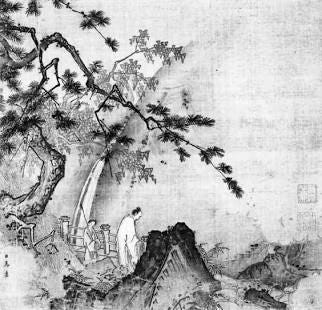
A Scholar Looking at a Waterfall
by Mǎ, Yuǎn
Source: Chinasage
To grasp this generative quality, we must distinguish it from the Western artistic concept of negative space. In the Western tradition, negative space is typically privative: it is space left empty in support of shaping, outlining, or emphasizing what is painted. Negative space allows the viewer of the Artwork, with the help of what has not been painted, to see what has been painted. In stark contrast, Liúbái is generative: it allows the viewer of the Artwork to see what has not been painted. The brushstroke is a boundary that makes the surrounding void a tangible, breathing reality. It invites the life force of the universe to flow through the open paper: 氣, Qì (Life’s Everflowing Energy.)
When this aesthetic sensibility traveled East from China, it was embraced by the Artists and Zen monks of Japan. They adopted the practice of leaving the paper bare, translating the concept into their own artistic vocabulary as: 余白, Yōhaku (Remaining white space.) While the two terms appear nearly identical on the surface, this transition across the sea brought a subtle but important shift in meaning. First, Chinese Liúbái is deeply tied to the flow of vital energy: 氣, Qì. The empty space is treated as a dynamic, moving medium through which the life force of nature circulates. Second, Japanese Yōhaku shifts the focus toward rustic simplicity and contemplative stillness. It is closely aligned with the aesthetic of finding beauty in impermanence and imperfection: 侘寂, Wabi Sabi (The beauty of the imperfect and impermanent.) By moving from the dynamic circulation of energy in China to the quiet stillness of Japan, we find a perfect bridge to the temporal world. This aesthetic of remaining space is not limited to the canvas. In Japanese culture, the physical space of the painting opens up into the temporal interval: 間, Ma (The physical or temporal gap.) When this concept is applied to interaction, it becomes: 間合い, Maai (Distance between partners, engagement distance, appropriate opportunity, suitable time, fitting into intervals.) In the practice of Martial Arts, Maai is the living distance between two practitioners. It is a dynamic relationship where space, time, and intention harmonize. Rather than a static gap to be crossed, Maai is a space where we must receive the other into our space, look for them, connect with them, effect a change, and offer a resolution.
This delicate dance of presence and absence draws directly on the concept of: 無, Wú (Nonbeing or absence.) This is a truth recorded by the ancient Sage: Lǎo Zǐ (老子.) In his legendary work, the 道德經, Dàodéjīng (Classic of the Way and its Qualities), we learn that a vessel is only useful because of its hollow interior. This generative absence is not a lack, but a functioning reality. To experience this is to cultivate an inner state of responsiveness: 虛, Xū (Empty or vacuous.) We see this responsive state in the way a master moves through the world, navigating gaps rather than forcing through solid structures. This is the essence of frictionless behavior: 無為, Wúwéi (Frictionless behavior.) This is the same quiet skill exemplified by the legendary butcher described by the ancient Sage: Zhuāng Zhōu (莊周.) The butcher moves his blade solely through what is already empty. In Chán Buddhism, this substantial emptiness is expressed through the concept of the void: 空, Kōng (Emptiness or void.) This concept of the void is deeply connected to the Sanskrit term for emptiness: शून्यता, Śūnyatā (Emptiness.) This is not a sterile void, but a field of relational potential, as declared in the famous phrase: 色即是空, 空即是色, Sè jí shì kōng, kōng jí shì sè (Form is emptiness, emptiness is form.) Classical poetry uses a linguistic version of this principle, where meaning lives in the resonant space around the words: 意境, Yìjìng (Mood, Atmosphere.)
Why must we travel through these valleys of landscape paintings, ancient scrolls of philosophy, and the silent distances of Martial Arts? The answer lies in our own internal landscape. What we make in our minds, where our thoughts, sensations, and feelings arise, is generative where nothing was made. In Guided Meditation, we often struggle against our thoughts, treating them as intrusive noise that ruins our focus. We mistakenly treat silence as a form of Western negative space, hoping to outline and isolate our quiet state by pushing thoughts away. But when we apply the wisdom of Liúbái, a profound shift occurs. The arising thought is not a distraction; it is the brushstroke of ink. The sensation of tension in the body is the line that defines the paper. By simply observing the thought, we generate a vast field of emptiness all around it. This emptiness is not a void of nothingness; it is Ma, a substance of pure awareness. We are navigating the internal equivalent of Maai, harmonizing our distance from the thoughts without grasping or repelling.
Every concept we have touched, from the mist covered mountains of the painter to the quiet distance of the fighter, has been in service of a single, practical deployment: the practice of Guided Meditation. When we sit in silence, we are not trying to paint a blank white wall. We are the Artists of our own consciousness. We look to the East to find a way to live in harmony with our internal world. Just as the Five Organs of the body function in harmony, or the Four Seasons transition from Autumn to Winter, our thoughts must be allowed to rise and fall naturally. By treating our thoughts as brushstrokes, we transform the quiet intervals of our minds into a substantial, healing presence. The silence we seek is not the absence of thought. It is the beautiful, generative emptiness that our thoughts create. We have learned the principles of the Sage so that we may finally close our eyes, breathe, and experience the substance of our own awareness.
The Breathing Canvas:
a Guided Meditation on the Nature of Space and self
Let us begin this Guided Meditation by settling into a posture of quiet comfort. Whether you are sitting on a cushion or a chair, feel your body release, feel the weight of your body settling down, feel the weight of our body received by all that is beneath.
We begin with the practice of quiet sitting: 靜坐, Jìngzuò. Let your hands rest on your thighs, or join them together to form a traditional gesture of focus. Close your eyes, or let your gaze rest softly on the floor.
Take a deep breath in, feeling the cool air enter your nose, and then - after appreciating the inbreath - let it out with a slow sigh.
This breath is the movement of your vital life force.
As you breathe, feel your shoulders drop away from your ears, feel your shoulders releasing the accumulated tension of the day, of the week, of the season, of the years.
...
...
Now, as a thought or a somatic sensation arises, we do not react with friction. Instead, we apply the martial wisdom of engagement: 間合い, Maai. We treat the thought as a partner in a delicate dance of awareness. First, we receive the thought into our space. We do not push it away. Second, we look for its presence, acknowledging its shape and where it sits in our being. Third, we connect with it, touching it with our breath. Fourth, we effect a change, letting the breath soften the edges of the thought. Finally, we offer the thought or sensation back to the silence.
Through this five step path of Maai, the thought ceases to be a distraction. It becomes the very brushstroke that defines the vast, open interval of our awareness: 間, Ma (The physical or temporal gap.) The thought is the ink. The silence around it is the Ma, a rich and tangible substance of peacefulness.
...
Feel the spaciousness of this moment. You are not a blank wall; you are a living canvas. Like the mist in the valleys of the cold Winter, or the bright warmth of the coming Spring, your thoughts come and go in their own natural cycles. Feel the silence breathe. Feel the space between your thoughts expand. You are navigating your internal landscape with the grace of a Martial Arts master, dwelling in the generative emptiness that your own mind creates.
Thank you.